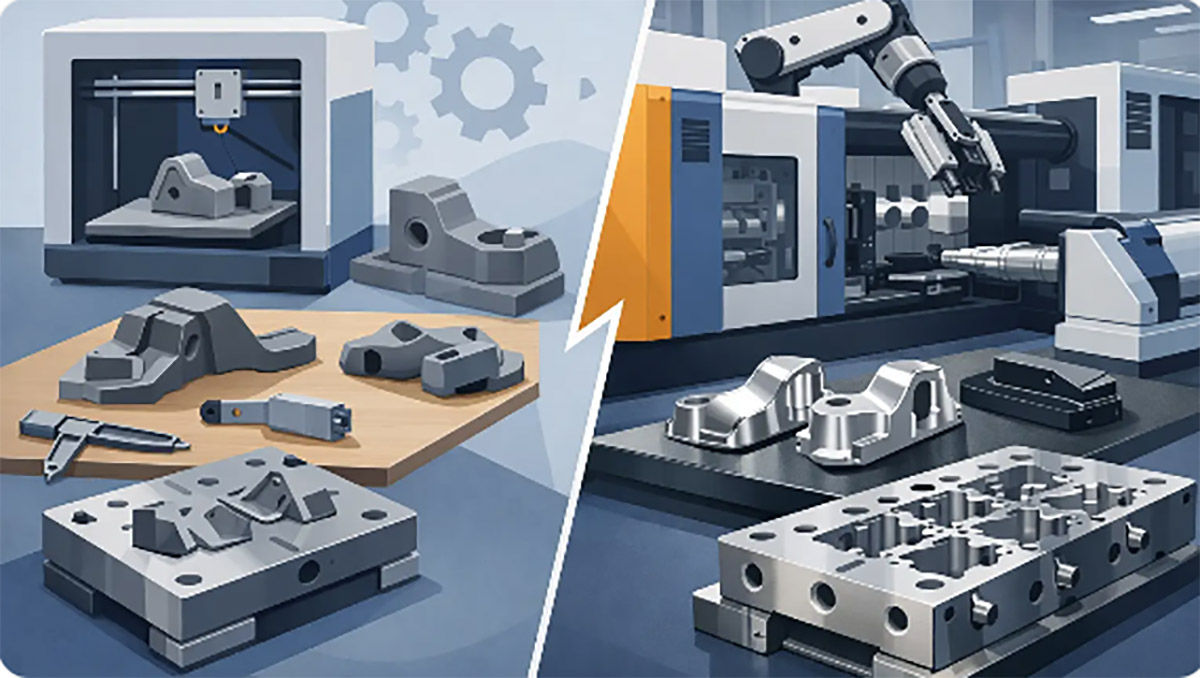
Learn what is rapid prototyping used for, from design validation and functional testing to DFM reviews, pilot builds, and lower-risk production decisions.

A
CAD model can look finished while still hiding the problems that cause a
product launch to slip: an enclosure that cannot be assembled, a wall that
molds poorly, a connector that is inaccessible, or a part that costs too much
at volume. That is what rapid prototyping is used for in practical product
development. It turns drawings and digital models into physical evidence early
enough to make changes without committing to production tooling.
For product companies,
engineers, and sourcing teams, a prototype is not simply a presentation model.
It is a decision-making tool. It helps teams verify fit, function, appearance,
assembly sequence, material behavior, and manufacturing feasibility before the
cost and lead time of injection molds, die-casting tools, stamping dies, or
high-volume production are involved.
What Is Rapid Prototyping Used For?
Rapid prototyping is used to build parts or assemblies
quickly from a design file so a team can evaluate a product before full
production. Depending on the requirement, the prototype may be a simple visual
model, a dimensionally accurate fit-check part, a functional mechanical
component, or a small pilot build that closely represents the final product.
The right method depends on
what must be learned. SLA printing can produce detailed parts with smooth
surfaces for appearance reviews. SLS can make durable nylon components for
functional checks and complex geometries. CNC machining is often selected when
tighter tolerances, production-like plastics, or metal properties matter.
Silicone tooling and low-volume injection molding are useful when teams
need multiple parts in a material closer to the final molded component.
A rapid prototype does not
need to reproduce every production detail. It needs to answer the current
question with enough confidence to support the next decision. Using a
high-fidelity CNC prototype to evaluate an early grip shape may add cost
without adding useful information. Conversely, using a cosmetic 3D print to
approve a load-bearing bracket can create false confidence.
Validating the Product Concept
The earliest use is concept validation. Industrial
designers and product managers use physical models to assess size, ergonomics,
visual proportion, user interaction, and overall product feel. A handheld
consumer device, for example, may require several enclosure iterations before
button position, grip, and balance are acceptable.
Physical evaluation catches
issues that renderings do not always reveal. A sharp edge, an awkward cable
exit, insufficient finger clearance, or a poor interface between two components
can become obvious as soon as the product is handled. At this stage, speed
usually matters more than final material performance, so SLA, SLS, or
lower-cost CNC options can be appropriate.
Checking Fit, Tolerances, and
Assembly
As a design matures, rapid prototyping becomes a
fit-and-assembly exercise. Engineers use prototypes to verify that parts mate
correctly, fasteners can be installed, printed circuit boards fit within their
enclosures, and moving features have adequate clearance.
This is particularly valuable
for multi-part products. A molded housing may interface with metal brackets,
silicone buttons, lenses, gaskets, batteries, and purchased hardware. Each
individual component can meet its drawing dimension yet still create an
assembly problem when tolerance stack-up is considered. Building the assembly
exposes those interactions before tooling is released.
CNC machining is often preferred for
this work because it can achieve controlled dimensions in engineering plastics
and metals. When the final part will be injection molded, the prototype should
also be reviewed for draft, wall thickness, ribs, undercuts, snap fits, and
gate-related considerations. A prototype confirms whether parts fit;
manufacturability review confirms whether they can be made consistently at the
target volume.
Functional Testing and Engineering
Verification
Rapid prototypes are used for functional testing when
a team needs more than visual confirmation. The part may be tested for
mechanical movement, load capacity, heat exposure, fluid flow, vibration
response, or repeated-use performance.
Material selection becomes
more important here. An SLA resin can accurately show geometry but may not
reflect the impact resistance or long-term behavior of an injection-molded ABS,
PC, nylon, or TPE component. Machined material or SLS nylon can provide a
closer functional approximation, but neither automatically duplicates the final
production material or process. Test results should be interpreted in that
context.
For electronics products,
prototypes support enclosure testing alongside PCB development. Teams can check
display windows, port alignment, antenna clearance, battery installation, cable
routing, heat dissipation, and service access. A complete engineering prototype
may combine machined or printed housings with off-the-shelf hardware, custom
silicone elements, sheet metal, and electronic assemblies.
Where safety, regulatory, or
demanding environmental requirements apply, prototype testing also helps
identify risks before formal qualification. It does not replace final
certification testing on production-representative units, but it reduces the
chance of reaching that stage with a basic design fault still unresolved.
Supporting DFM and DFA Decisions
One of the most commercially
useful purposes of rapid prototyping is design for manufacturability and design for assembly
review. The question changes from "Can we make one?" to "Can we
make this repeatedly, at the required quality and cost?"
A prototype gives
manufacturing engineers a physical reference for identifying features that may
increase tooling complexity, cycle time, scrap risk, or assembly labor. Common
findings include walls that need more uniform thickness, snap fits that need
revised geometry, screw bosses that need reinforcement, tight corners that
require radii, or cosmetic surfaces that need a realistic finish specification.
Prototype assemblies also
reveal whether a product can be built efficiently. If an operator needs to flex
a component excessively, use an unusual tool angle, or perform a difficult
alignment step, the assembly may be slow or inconsistent in production.
Revising the design before tooling can reduce labor content and improve quality
control at the same time.
Low-Volume Builds, Market Samples,
and Supplier Alignment
Rapid prototyping is also used to produce limited
quantities before mass production. These parts may support customer samples,
trade-show units, internal demonstrations, field trials, photography, or early
market feedback. For startup teams and established OEMs alike, a small run can
help validate demand before a significant tooling investment.
When quantities increase, the
process may shift from individual printed or machined parts to silicone
tooling, urethane casting, bridge tooling, or low-volume injection molding.
This transition is useful because it begins to test the actual supply chain:
material availability, component sourcing, finishing, assembly instructions,
packaging, inspection methods, and delivery timing.
A pilot build is especially
useful before production launch. It allows the team to confirm that drawings,
bills of materials, fixtures, work instructions, and inspection criteria are
complete. It also provides units for evaluating cosmetic consistency and
packaging protection. The goal is not only to produce samples, but to prove
that the manufacturing process can be controlled.
For complex products,
consolidating these activities with a manufacturer that can handle prototyping,
tooling, production components, sourcing, and assembly can reduce handoff errors.
Xiamen Creator Technology supports this type of progression by coordinating
prototype methods with the requirements of later tooling and production work.
Choosing a Prototype Method Based
on the Decision
Selecting the fastest process is not always the best
choice. The selection should start with the decision the prototype must
support, followed by required quantity, tolerance, material behavior, surface
finish, and delivery target.
Four common approaches serve
different needs:
·
SLA prototypes are suited to detailed visual models, small features, and smooth
cosmetic surfaces. They are useful for appearance and fit checks but may have
limitations in strength and heat resistance.
·
SLS prototypes are commonly used for durable nylon parts, complex internal shapes,
and functional assemblies. Surface texture and dimensional finish may require
post-processing.
·
CNC-machined prototypes support tight tolerances, production-like engineering materials, and
metal components. They are often chosen for functional validation, but complex
geometry can increase machining time and cost.
·
Silicone tooling or low-volume molding helps teams evaluate multiple parts in a
material and process closer to molded production. It requires more setup than a
single printed part but provides better insight for small-run needs.
The best program may use more
than one method. A team might begin with SLA appearance models, move to CNC
housings for fit and electronics integration, then use low-volume molded parts
to confirm cosmetic finish and assembly before hard tooling.
Avoiding Common Prototype Mistakes
A prototype program loses value when its purpose is
unclear. Before requesting quotations, define what the part must prove and what
conditions it will face. Include critical dimensions, mating components, target
material, expected load or temperature, surface requirements, and the number of
units needed.
It is also wise to identify
which features are provisional. Not every detail needs to be refined in the
first build, but critical interfaces should be controlled. If a prototype is
being used for assembly verification, provide the actual PCB, purchased
hardware, seals, or mating parts whenever possible. Testing an assembly with
assumed dimensions can postpone the real problem rather than solve it.
Finally, treat prototype
feedback as controlled engineering input. Record changes, revise drawings, and
confirm that the approved design matches the version released for tooling.
Informal changes made during sampling are a frequent source of production
mismatches.
The most effective rapid
prototype is not necessarily the most polished one. It is the one that answers
the next manufacturing question early, clearly, and at a cost that leaves room
to improve the product before production commitments are made.